What Is a VIN and How to Check One in Ghana Before You Pay
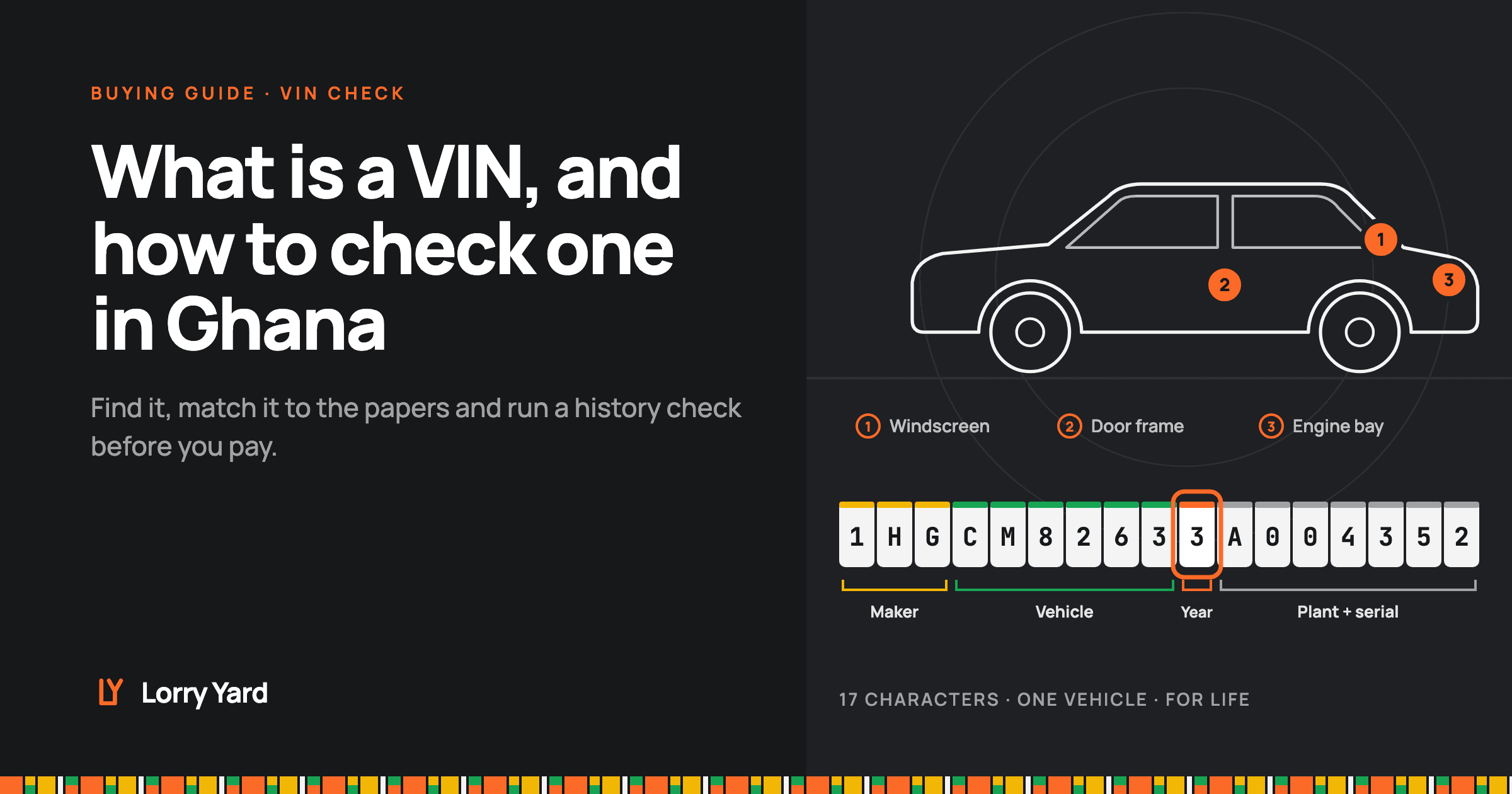
A VIN (Vehicle Identification Number) is a unique 17-character code that identifies one specific vehicle. To check a VIN in Ghana, find it in at least three places on the vehicle, make sure it matches every document exactly, then run a VIN history report to see whether the vehicle has been reported stolen, has money owed on it, or has a damage history. Do all of this before any money changes hands.
If you only learn one thing before buying a vehicle in Ghana, make it this. The VIN is the vehicle's fingerprint. Scammers can change a number plate, repaint a car or forge a receipt, but a VIN that doesn't match is very hard to explain away.
New to buying? Start with our complete guide: How to Buy a Used Car Safely in Ghana.
What is a VIN?
A VIN is a 17-character code of letters and numbers given to a vehicle when it is made. No two vehicles built to the modern standard share the same VIN. It stays with the vehicle for life, through every owner, country and number plate.
A few facts that help you spot fakes:
- A modern VIN is exactly 17 characters long.
- It never contains the letters I, O or Q, because they are too easy to confuse with 1 and 0.
- It is stamped or printed on the vehicle in several places, and recorded on its official documents.
In Ghana, people often call it the chassis number. On most cars, buses and trucks imported from the US, Canada and Europe, the chassis number and the VIN are the same thing.
One exception to know: some vehicles built for the Japanese home market carry a shorter frame number instead of a 17-character VIN. That doesn't automatically mean something is wrong, but it does mean you should rely even more on the documents and an official check.
What the 17 characters tell you
You don't need to decode a VIN yourself, but knowing the basics helps you spot a number that doesn't make sense for the car in front of you.
| Characters | What they mean | What to check |
|---|---|---|
| 1–3 | Manufacturer and country (World Manufacturer Identifier) | Does it match the brand? A Toyota VIN shouldn't decode as a Honda. |
| 4–8 | Vehicle details: model, body type, engine | Does it match the model and engine you're being sold? |
| 9 | Check digit (on North American vehicles), a security digit calculated from the others | A free VIN decoder will flag a VIN that fails this check. |
| 10 | Model year | Does it match the year on the listing and the papers? |
| 11 | Assembly plant | Useful for history reports. |
| 12–17 | Serial number for that exact vehicle | Must be identical everywhere. |
Quick test: type the VIN into a free online VIN decoder. If the make, model or year it shows doesn't match the vehicle you're looking at, stop and ask questions.
Where to find the VIN on a vehicle
Check at least three of these, and make sure every one is identical:
- Base of the windscreen, on the driver's side. You can read it from outside the car.
- Driver's door frame, on a sticker or plate visible when the door is open.
- Engine bay or firewall, stamped into the metal.
- Under the carpet or seat on some models, stamped into the floor.
- Other parts, such as seatbelt labels, the boot floor or major body panels on some vehicles.
For trucks, buses and tricycles, the chassis number is usually stamped on the frame rail and printed on a plate in the cab or near the engine. Ask the seller to show you, and bring a torch.
Warning signs on the car itself:
- Numbers that look scratched, ground down, re-stamped or uneven
- A VIN plate held on with the wrong rivets or glue, or one that looks newer than the car
- A replaced door-frame sticker
- Any location where the VIN should be, but has been painted over or removed
Match the VIN to every document
A VIN on the car is only half the check. It must also match the paperwork, character for character.
Compare the VIN on the vehicle with:
- The DVLA vehicle registration documents
- Customs documents (for imported vehicles)
- The roadworthy certificate
- The insurance certificate
- The LorryYard listing, if you found the vehicle there
Ghana's Economic and Organised Crime Office (EOCO) has warned buyers to check the VIN across all documents and parts of the car, and to treat any alteration or mismatch as a sign of fraud. One wrong character is enough to walk away.
Run a VIN history check
Once the VIN matches, find out where the vehicle has been. A VIN history report can show:
- Whether it has been reported stolen
- Whether there is a lien, meaning a bank or lender still has a claim on it
- Recall notices from the manufacturer
- Accident, flood or salvage records from its country of origin
- Mileage readings recorded over time, to spot a rolled-back odometer
You can run a VIN check on LorryYard for history, lien and theft, or recall status before you buy or sell.
For high-value vehicles, EOCO advises confirming with official authorities before you pay. It notes that free VIN check websites may not give full coverage. A paid report plus official confirmation is the safest combination.
Why LorryYard lists every VIN only once
On many classifieds sites and social media groups, one vehicle can be advertised dozens of times: by the owner, by several "agents", and sometimes by scammers using copied photos. Buyers can't tell which ad is real.
LorryYard was built to stop that. Every seller uploads the vehicle's VIN when they post an ad, and a VIN that is already on the platform can't be listed again. That gives you:
- One vehicle, one listing, one seller. No confusing duplicates at different prices.
- No cloned ads. A scammer can't re-post a genuine vehicle's photos and details as their own.
- A number to check from the start. The VIN on the listing is the same number you'll match on the vehicle and its papers.
A unique listing is a strong starting point, not a replacement for your own checks. Always match the VIN in person and run a history report before you pay.
Browse VIN-linked vehicles on LorryYard →
Your VIN checklist
- The VIN is 17 characters, with no I, O or Q
- A free decoder shows the right make, model and year
- The VIN matches in at least three places on the vehicle
- No signs of scratching, re-stamping or replaced plates
- The VIN matches the DVLA, customs, roadworthy and insurance documents
- A history report shows no theft, lien or hidden damage
- For high-value vehicles: confirmed with the authorities before paying
Frequently asked questions
Is the chassis number the same as the VIN?
On most modern vehicles sold in Ghana, yes. Some Japanese-market vehicles use a shorter frame number instead of a 17-character VIN, so check the documents carefully and consider an official verification.
Can I check a VIN for free in Ghana?
You can use a free VIN decoder to confirm the make, model and year. For theft, lien and damage history, you'll need a paid report. EOCO notes that free sites may not cover everything.
What should I do if the VIN doesn't match?
Don't pay, and don't take the vehicle. Ask the seller to explain in writing. If you suspect the vehicle is stolen, report it to the Ghana Police Service.
Can a VIN be changed?
Criminals sometimes grind off and re-stamp VINs or swap VIN plates from another vehicle. That's why you check several locations and the documents, not just one plate.
Do I need a VIN to sell on LorryYard?
Yes. Every listing is tied to its VIN, and each VIN can only be listed once. This keeps the marketplace free of duplicate and cloned ads.
Buy with the VIN on your side
On LorryYard, every vehicle comes with its VIN from the first click, and no vehicle appears twice.
Browse vehicles → · Run a VIN check →
This guide is for general information and doesn't replace official guidance from DVLA, the Ghana Police Service or EOCO.